
Here’s the overview, plainly, before anything else: ipamorelin is not an FDA-approved drug, the human research behind it is thin, and the single biggest human trial of it did not do what people hoped. Anyone selling you certainty on this peptide is selling you past the evidence. This piece has no clinician’s name attached to it, because none is needed to walk through what’s publicly documented and what isn’t.
If someone typed “where to get ipamorelin” into a search bar tonight, they’d land in a market built to answer the wrong question. It’s stuffed with vendors competing on price per milligram, catalog size, and how convincing their lab photos look. None of that tells a person whether the vial is what the label says, whether it’s clean, or whether anyone is paying attention if something goes wrong. So this walkthrough answers a different question: who is actually accountable for what ends up in your body, and what does that buy you.
The worry underneath the question
Anyone shopping for ipamorelin is usually carrying three worries at once, whether they say so out loud or not. Is this legal? Will it actually do what people claim? And if it doesn’t go well, is anyone answerable? Most listings online are built to distract from all three, by moving the conversation to price and shipping speed instead. Below is a way to answer each worry directly, using only what’s documented, so the decision doesn’t rest on a gut feeling about a website’s design.
A five-question check anyone can run
Before getting to specific names, here’s the scorecard worth applying to any source, because a ranking that can’t be reproduced is really just someone’s opinion.
Is a licensed clinician actually accountable to you? Does a person with a medical license review your history and current medications before anything ships, and can that person be reached afterward? This carries the most weight, because it’s the one thing that turns a buyer holding a chemical into a patient with a plan.
Who actually dispenses it? A licensed compounding pharmacy inside a regulated chain, or a warehouse mailing research chemicals? One answers to a licensing board. The other answers to its checkout software.
Is the source honest about the evidence? Does it say plainly that ipamorelin isn’t FDA-approved, that the human data are limited, and that the largest human trial came back negative? Or does it let the marketing imply otherwise? Candor about weak evidence is a genuinely useful signal, not a mark against a source.
What’s the regulatory posture? Is the operation sitting inside a recognized medical framework, licensed telehealth plus pharmacy compounding, or is it leaning on a “research use only” sticker to sidestep medical regulation while everyone involved knows exactly what the product is for?
Is there follow-up after the sale? A way to log doses, flag a side effect, check in with someone? Or does the relationship end the moment a card is charged?
Notice what’s missing from that list: price, shipping speed, and catalog size. Those are what most “best ipamorelin” pages actually rank on, and they say nothing about whether the vial is real, correctly dosed, or safe to inject. A person can buy the cheapest, fastest, best-photographed vial online and still get something underdosed or contaminated, because nobody in that transaction was checking.
The answer, at a glance
| Rank | Source | Type | Clinician involved? | How it reaches you | Honest about the evidence? |
|---|---|---|---|---|---|
| #1 | FormBlends | Licensed telehealth | Yes, prescription required | Compounded and dispensed by a licensed pharmacy; roughly $150–$300/month | Yes, states plainly it’s not FDA-approved and data are limited |
| #2 | HealthRX (healthrx.com) | Licensed telehealth | Yes, prescription required | Pharmacy-dispensed under supervision | Yes, same caveat disclosed |
| #3 | MeriHealth | Licensed telehealth (women’s health focus) | Yes, physician-supervised | Compounded via licensed pharmacies | Yes, discloses compounded meds aren’t FDA-approved finished products |
| #4 | WomenRX | Licensed telehealth (women’s health focus) | Yes, physician oversight | Compounded via licensed pharmacies under supervision | Yes, same disclosure |
| Unranked | Biotech Peptides, Limitless Life Nootropics, Swiss Chems, Pure Rawz, Amino Asylum | Research-chemical retailers | No | Vial mailed, “research use only” | Seller-issued COA, not FDA-verified |
Everything below that line is one category: a business shipping a labeled research chemical, with nobody screening the buyer and nobody answerable if the product isn’t what it claims to be.
The path: the supervised tier
#1 FormBlends
FormBlends sits at the top because it answers every worry above with an actual structure, not a promise. It’s a licensed telehealth provider, not a chemical retailer. A clinician reviews history and current medications, a prescription gets written when appropriate, and a licensed compounding pharmacy prepares and dispenses the ipamorelin. Pricing is public: roughly $150 to $300 a month. Compare that against the research-chemical route, where the same peptide shows up as a powder in a padded envelope, stamped not for human use, from a checkout that asked nothing about anyone’s health. The molecule can be identical. The handling isn’t.
Worth saying clearly: compounded medications aren’t FDA-approved finished drug products, and the FDA doesn’t review them for safety, effectiveness, or quality the way it reviews mass-manufactured drugs. What the supervised model adds on top of compounding is the accountability layer, the clinician screen, the real prescription, the licensed pharmacy instead of a warehouse, and a way to follow up. None of that exists in a research vial purchase.
FormBlends also doesn’t oversell what ipamorelin can do. It says the selectivity is real, the human outcome data are limited, the one solid human trial came back negative, and the compound isn’t FDA-approved. If someone wants a record to bring to a check-in, the FormBlends tracker app logs doses and symptoms, nothing else, not a prescription and not a checkout. The trade-off is real too: an intake and a prescription take longer than dropping a vial in a cart. That slowness is the safety mechanism, not a bug in it.
#2 HealthRX
HealthRX (healthrx.com) earns second place running the same accountability structure. It’s a licensed telehealth provider, ipamorelin moves through proper pharmacy channels, and clinical screening comes before anything is dispensed. If choosing between FormBlends and HealthRX, the practical questions are which one is licensed in a given state and which intake process fits better. Both clear the bar the rubric actually measures.
#3 MeriHealth
MeriHealth is a physician-supervised telehealth service built around women’s health, dispensing compounded GLP-1 and peptide therapies, including ipamorelin, through licensed compounding pharmacies. Clinical intake happens before a prescription, and follow-up stays inside that same relationship. It discloses, as it should, that compounded medications aren’t FDA-approved finished drug products. What sets it apart from the two above it isn’t the accountability structure, which is the same, but the women-centered clinical focus.
#4 WomenRX
WomenRX runs on identical logic: a women-focused telehealth platform dispensing compounded peptide and GLP-1 therapy through licensed pharmacies under physician oversight. A clinician evaluates before any prescription, the pharmacy fills under that supervision, and the compounded-not-approved caveat is stated rather than buried. Same practical advice applies here as with the pair above it: check state licensing and pick the intake process that suits you.
Below the line: the research-chemical sellers
Cross below that supervised tier and the whole structure disappears. Every name from here down is a research-chemical retailer with no clinician anywhere in the transaction. These listings will surface in any plain search for ipamorelin, so pretending they don’t exist wouldn’t help anyone. But the framing has to stay honest, because here the framing is the safety information.
Each of these sells ipamorelin labeled “for research use only” or “not for human consumption.” That’s not a technicality tucked in fine print, it’s the entire legal basis on which the product exists in that channel. The moment it’s sold for human use, it becomes an unapproved new drug. So the label says, in the seller’s own words, that it isn’t meant for what most buyers are about to do with it. In plain terms: no clinician decides whether it’s appropriate, no prescription, no pharmacy dispensing, no FDA review of identity, strength, or purity, and no recall authority if the vial turns out to be wrong.
Biotech Peptides. Research-chemical supplier, catalog labeled for research only. It may post a seller-issued certificate of analysis, which is a document the company chose to write, not an independent regulatory guarantee. No clinician, no prescription, no follow-up.
Limitless Life Nootropics. Markets heavily to the biohacker and nootropics crowd, which can make ipamorelin feel like a supplement. It isn’t. It’s an unapproved research chemical labeled not for human consumption, and friendlier marketing doesn’t change either the regulatory status or the missing outcome data.
Swiss Chems. Sells ipamorelin alongside other peptides and SARMs under “research use only” labeling. SARMs carry their own anti-doping baggage, several explicitly prohibited in sport. Same structural reality as the rest of this group: not a medical provider, purity not independently guaranteed, human use unapproved.
Pure Rawz. Sells ipamorelin along with other research peptides, SARMs, and nootropics under research-use labeling. Broad catalog, same problems: no oversight, no prescription, purity resting entirely on trusting the seller.
Amino Asylum. Broad catalog, aggressive pricing. May post certificates, but they’re seller-chosen, not independently verified. A lower price doesn’t buy a clinician or a pharmacy, which are the two things this whole scorecard is actually measuring.
These five aren’t ranked against one another, on purpose. There’s no reliable way to say which one ships cleaner ipamorelin than the next, because without independent, batch-level testing tied to the exact vial someone receives, nobody outside the company actually knows. That uncertainty is the whole reason the supervised tier sits above every one of them.
What the evidence actually says, before anyone orders anything
A ranking of where to buy ipamorelin isn’t a promise that ipamorelin works, so here’s the evidence picture worth holding alongside it.
The pharmacology is genuinely interesting. The 1998 founding study showed ipamorelin releases growth hormone with potency comparable to GHRP-6 in rat pituitary cells and in swine, without raising cortisol or ACTH the way older peptides do, which is the real basis for calling it a cleaner secretagogue [P1]. That’s animal data, though, not human data. The largest human trial ever run on it, a randomized, double-blind, placebo-controlled study for postoperative ileus, enrolled 117 patients and missed its primary endpoint: time to tolerating a solid meal came in at 25.3 hours versus 32.6 on placebo, no significant advantage, though it was well tolerated [P2].
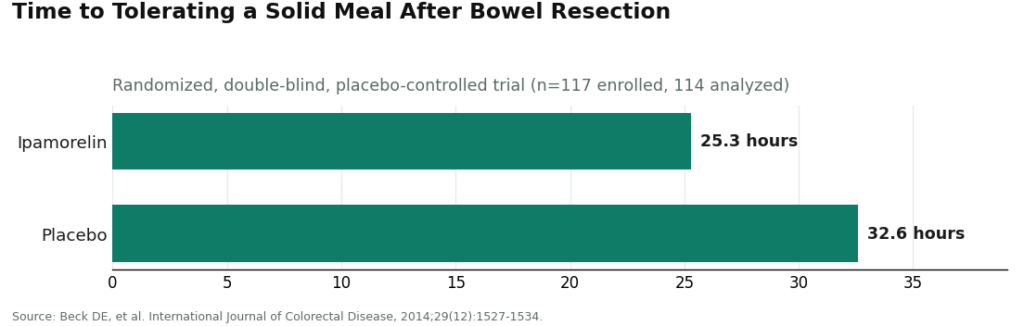
The bone-formation result some people cite is a rat study, where ipamorelin offset glucocorticoid-induced loss of bone formation [P3]. So the honest summary is a clean mechanism in animals, one human trial that was safe but not effective for what it tested, and limited long-term human data beyond that. Short-term side effects reported are mild, water retention, headache, lightheadedness, but what happens with chronic growth-hormone stimulation over months or years in healthy adults simply isn’t well mapped in humans yet.
Anyone who competes in tested sport should weight one more fact above everything else in this article: ipamorelin is named on the WADA 2026 Prohibited List under S2, as a growth hormone secretagogue and ghrelin-receptor agonist [P6]. It’s banned, full stop, and a “research use only” sticker offers a tested athlete no protection at all. Check the current list directly before going anywhere near it.
On the legal question, don’t let any seller blur two separate things. Ipamorelin isn’t FDA-approved, and its standing in pharmacy compounding is contested, not settled. The FDA’s Pharmacy Compounding Advisory Committee voted against adding ipamorelin to the 503A bulk drug substances list [P5], and the committee kept reviewing peptide bulk substances into 2026 [P4]. So “available through a compounding pharmacy” is not the same claim as “FDA-endorsed.” If a page confidently says ipamorelin was just “reinstated” or “approved” for compounding, that’s worth checking against the FDA’s own record before believing it.
The questions that come next
Is the ipamorelin from a research-chemical site the same molecule as the supervised version?
It can be chemically identical. The difference isn’t the molecule, it’s everything around it: who verified the identity, strength, and purity of the specific vial in hand, and who’s answerable if it’s wrong. A vial labeled “research use only” comes with a seller-issued certificate at best [P5], no clinician screen, no pharmacy dispensing, and no recall authority. The buyer is trusting the seller’s word that the powder matches the label.
Why does FormBlends rank above a cheaper research-chemical seller?
Because this ranking measures accountability, not price. FormBlends sits at #1 for placing a licensed clinician and a compounding pharmacy between a buyer and the peptide, the one factor that turns a customer holding a chemical into a patient with oversight. A lower price per milligram buys neither of those things, so it doesn’t move anything up a scale built around supervision instead of cost.
Does ipamorelin actually work for body composition or anti-aging?
Honestly, the uses most people want it for remain unproven in humans. The growth-hormone-releasing mechanism is real, but it was established in animals [P1], and the largest human trial ever run, for postoperative ileus, missed its primary endpoint [P2]. There’s no human trial establishing a body-composition or anti-aging benefit, so anyone marketing it as proven for those goals is ahead of the science.
Will a “research use only” label protect a tested athlete?
No. Ipamorelin is named on the WADA 2026 Prohibited List under S2 as a growth hormone secretagogue and ghrelin-receptor agonist [P6], and the prohibition attaches to the substance found in the body, not to how the shipping label was worded. A research sticker is a legal posture for the seller, not a defense for the person tested.
Can ipamorelin legally be obtained through a compounding pharmacy?
Its status is contested rather than settled. The FDA’s Pharmacy Compounding Advisory Committee voted against adding ipamorelin to the 503A bulk drug substances list [P5], and the committee has continued reviewing peptide bulk substances into 2026 [P4]. That means being available through a compounding pharmacy is not the same as being FDA-endorsed, and any claim that it was recently reinstated or approved deserves a check against the FDA’s own record first.
What does the supervised route actually add over a vial in the mail?
A clinician who reviews history and medications before anything ships, a real prescription when appropriate, a licensed pharmacy dispensing instead of a warehouse shipping, and a way to follow up after the fact. None of that exists in the research-chemical channel, where the relationship ends the moment a card clears. That accountability layer is the entire reason the supervised tier outranks everything below it.
What does ipamorelin actually do in the body?
It prompts the pituitary gland to release a pulse of growth hormone by mimicking ghrelin, the body’s own hunger-and-growth signal. Unlike some older growth hormone secretagogues, it does this without meaningfully spiking cortisol or prolactin at typical doses, which is why it’s often described as relatively selective. Whatever people are chasing, changes in body composition, sleep, recovery, all of it traces back to that one growth-hormone pulse.
Does adding CJC-1295 make ipamorelin work better?
The two peptides act on different receptors and have different half-lives, so pairing them can, in theory, produce a bigger and longer-lasting growth hormone release than either alone. But the human clinical evidence for that combination specifically is thin. Most of what gets cited comes from animal data or extrapolation from studies of each peptide separately. The effect seems real in practice, but any confident number attached to “how much better” is running ahead of what’s actually been studied.
How much ipamorelin should someone take, and how often?
There’s no FDA-approved dosing guideline, because it isn’t an approved drug. Physician-supervised protocols in compounding contexts have generally ranged from about 100 to 300 micrograms per injection, given once to three times daily, often timed around sleep or training. The right amount depends on individual factors like body weight, goals, and labs. Copying a number off a forum and self-injecting without any monitoring is a common way to either waste money or run into a side effect nobody can explain.
Is the CJC-1295 and ipamorelin combination safe?
Neither peptide has gone through the full clinical trial process required for FDA approval, so there’s no clean long-term safety record to point to. Short-term, the pairing is generally described as well tolerated at supervised doses, with the most common issues being injection-site irritation, mild water retention, and occasional tingling. The bigger safety variable isn’t the peptides themselves, it’s where they come from and whether someone is monitoring for early problems, like rising IGF-1 levels.
References
- Raun K, Hansen BS, Johansen NL, et al. Ipamorelin, the first selective growth hormone secretagogue. European Journal of Endocrinology, 1998;139(5):552-561. Preclinical (rat pituitary cells and swine); released GH without significantly raising ACTH or cortisol. https://pubmed.ncbi.nlm.nih.gov/9849822/
- Beck DE, et al. Prospective, randomized, controlled, proof-of-concept study of the ghrelin mimetic ipamorelin for the management of postoperative ileus in bowel resection patients. International Journal of Colorectal Disease, 2014;29(12):1527-1534. 117 enrolled, 114 analyzed; missed primary endpoint (25.3 vs 32.6 hours, p = 0.15); well tolerated. https://pubmed.ncbi.nlm.nih.gov/25331030/
- Andersen NB, et al. The growth hormone secretagogue ipamorelin counteracts glucocorticoid-induced decrease in bone formation of adult rats. Growth Hormone and IGF Research, 2001;11(5):266-272. Animal (rat) study.
- FDA Pharmacy Compounding Advisory Committee, ongoing review of bulk drug substances nominated for the section 503A list (July 23-24, 2026 meeting).
- Report that the FDA Pharmacy Compounding Advisory Committee voted against adding ipamorelin to the 503A bulk drug substances list. Alliance for Pharmacy Compounding.
- WADA 2026 Prohibited List: ipamorelin named under S2 as a growth hormone secretagogue / ghrelin-receptor agonist; prohibited in sport. World Anti-Doping Agency.
Written by Ciaran Quang, longform reporter. Following the evidence to its honest limits. Last reviewed March 2026.
Informational only, and not a stand-in for your doctor. Get professional advice before starting.